


In many laboratories, design offices, and weighing rooms, integrating additive manufacturing equipment (FDM/SLA 3D printers) or recycling/extrusion equipment (filament makers) presents a real challenge: maintaining a stringent air cleanliness classification (e.g., ISO 7) while capturing ultrafine particle (UFP) and VOC emissions at the source.

Cleanroom at Lattice Medical with an Alveo3D Filtration Enclosure
I. The Challenge of Ultrafine Particle Emissions
Weighing rooms and analytical laboratories are subject to the ISO 14644-1 standard to ensure the control of airborne contamination when handling sensitive substances.
According to ISO 14644-1:2015, the maximum allowable particle concentration for an ISO 7 cleanroom is expressed as the maximum number of particles permitted per cubic meter of air.
| Particle size | Maximum allowable concentration |
|---|---|
| ≥ 0.5 μm | 352,000 particles/m³ |
| ≥ 1.0 μm | 83,200 particles/m³ |
| ≥ 5.0 μm | 2,930 particles/m³ |
- Challenge 1: 3D printing and filament manufacturing can generate large quantities of submicron particles and chemical vapors.
- Challenge 2: A poorly designed enclosure or one equipped with generic filtration may disrupt the room's airflow and increase the load on the cleanroom's central filtration system.
- Challenge 3: Laboratory setups combining a 3D printer, accessories, and weighing modules often require a custom-designed enclosure to meet space, airflow, and filtration requirements.

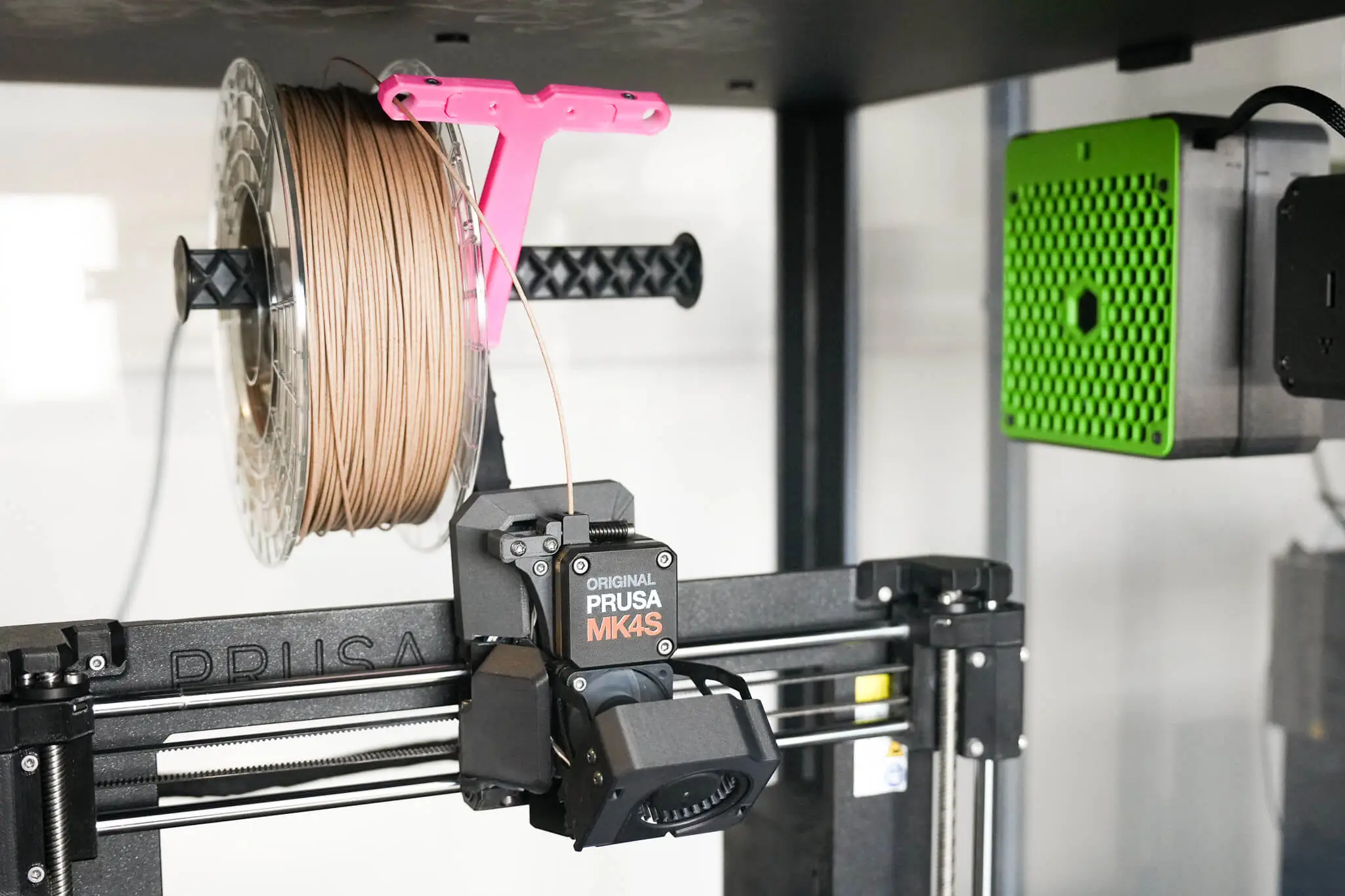
Custom Filtration Enclosure with Alveo3D Filtration for Filament Manufacturing
II. Solution: Custom Enclosure and Advanced Filtration
To meet the strict requirements of weighing rooms and ISO 7 areas, Alveo3D designs secure enclosures that fully isolate the source of emissions.
1. Custom Isolation and Containment
- A structure tailored to the dimensions of your equipment and the working ergonomics of your technicians.
- Certified materials suitable for laboratory environments.
2. Advanced Source Filtration System
- HEPA + Activated Carbon Combination: Effective capture of VOCs and particles down to the nanoscale.
- Maintaining ISO Cleanliness Levels: By treating pollutants directly inside the enclosure, emissions released into the room are minimized, helping maintain the cleanliness levels required for ISO-classified cleanrooms (ISO 7 / ISO 8).
3. Airflow Management and Thermal Stability
- Controlled airflow: Designed to prevent turbulence around precision balances and weighing equipment.
- Stable ambient temperature: Helps ensure reliable printing of technical materials such as ABS, PEEK, and Nylon while minimizing deformation and warping.

The custom-made cabinet manufactured in France
III. Why Choose Alveo3D for Your Custom Project?
- Expertise in industrial filtration for additive manufacturing.
- End-to-end support: From requirements analysis and 3D design to the integration of the extraction and filtration system, through to final validation.
- Compliance with occupational health and safety (OHS) requirements.